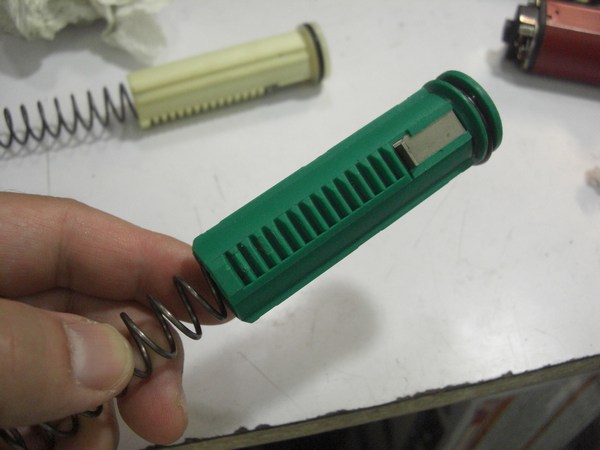
Aluminum is a light elemental metal notable for its relative lightness and resistance to corrosion. It is a soft metal which is easy to shape and is highly susceptible to impact damage. Therefore, even though it is stronger than resin, it is not of a mighty strength.
Frankly, if you do not go beyond 400FPS, an aluminum piston doesn’t make any significant difference in durability. In fact, with improper shimming and under constant improper usage, its teeth will still get striped anyway. And because the aluminum piston is heavy (at least heavier than a resin piston), it is going to suck up more battery power.
Resin is more of a generalized term for describing plastic-like material. Of the various plastic-like materials, there are nylon, polycarbonate and polyacetal. Generally speaking, nylon is softer than polycarbonate and can offer more toughness and resistance to fracture. In fact, good nylon construction often offer very good elasticity and toughness, thus allowing a piston to withstand heavy stresses without getting deformed. On the other hand, polyacetal (which is also known as polyoxymethylene) is not as strong as polycarbonate but can offer significantly more toughness. It also offers better inherent surface lubricity and as well as higher fatigue strength.